


News Center
The U.S. automotive market has been in turmoil, with sales surging 9.1% year-on-year to 1.59 million vehicles in March. The seasonally adjusted annual sales rate (SAAR) is projected to soar to 17.8 million units, the highest in four years. In March, sales of SUVs and pickup trucks rose 11.1% to 1.28 million units, while passenger car sales increased slightly by 1.4% to 312,000 units. Quarterly sales grew 4.4% to 3.928 million units in the first quarter. Due to the March buying spree, new vehicle inventory at dealerships dropped significantly. Total inventory stood at 2.69 million units at the end of March, compared to 2.99 million units at the beginning of the month. **March 2025 U.S. electrified vehicle sales performed strongly:** - Hybrid electric vehicles (HEVs) sold 193,419 units, a 56.1% year-on-year increase, including 62,939 sedans and 130,480 long-range models (predominantly SUVs and trucks). - Plug-in electric vehicles (PEVs) reached 153,132 units, up 18.3% year-on-year, including 115,309 battery electric vehicles (BEVs) and 37,823 plug-in hybrid electric vehicles (PHEVs). PEVs accounted for 9.66% of total light-duty vehicle (LDV) sales. - Fuel cell electric vehicles (FCEVs) remained negligible, with only 13 Honda CR-V FCEVs sold in March, bringing the cumulative sales to 69 units. **Brand and model sales analysis and competitive landscape:** - **Brand performance:** - Toyota dominated the HEV market with a 41.6% sales share in March, driven by hybrid versions of popular models like the RAV4 and Camry. - General Motors saw overall sales grow 17% in Q1 to 690,000 units. - **Model sales:** - Ford F-Series sales surged 24.5% year-on-year, further widening the gap with other models. - Chevrolet Silverado maintained its second-place position with a marginal 0.1% growth. - Toyota RAV4 fell to third place with a 7.5% sales decline. - Honda CR-V performed strongly, up 8.7%, ranking fourth and rapidly closing in on the top three. - The most notable performer this quarter was the Chevrolet Equinox, with a staggering 50.1% year-on-year sales increase, jumping six spots to fifth place in the 2024 fiscal year rankings. - Ram Pickup remained sixth despite an 11.8% sales decline, narrowly leading GMC Sierra (+14.5%) by just 307 units. - Tesla Model Y plummeted 29.1% in sales, falling to eighth place. - The only sedan in the top 10 was the Toyota Camry, which also saw a 10.2% sales decline. - Nissan Rogue suffered a significant 31.6% sales drop, ranking 10th. - Toyota Tacoma rebounded from last year’s slump with a 177.5% growth, rising from 17th to 11th place in annual rankings for 2024.
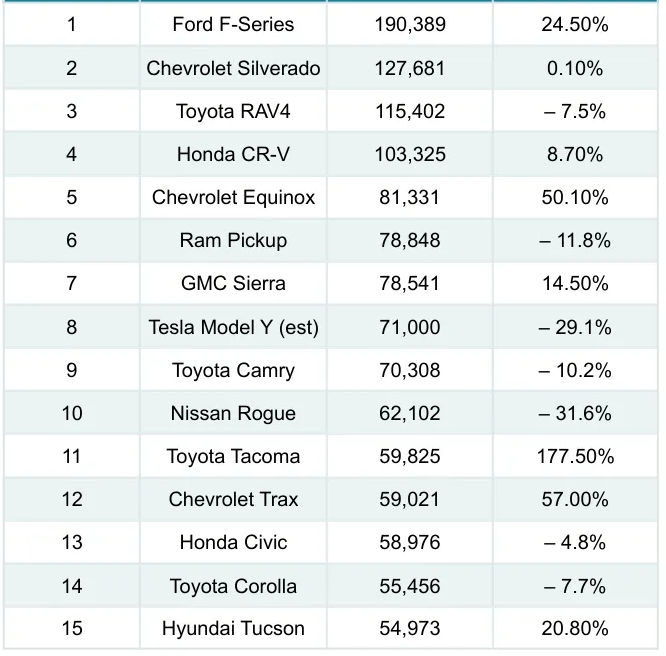
● **In the passenger car segment:** - Honda Civic sales fell slightly by 4.8%, ranking 13th, below the Toyota Camry but above the 14th-ranked Toyota Corolla (-7.7%) and the 16th-ranked Nissan Sentra (+36.1%). - While both the Chevrolet Trax (+57%) and Hyundai Tucson (+20.8%) saw sales growth, their rankings declined slightly. These shifts reflect the market’s continuing preference for SUVs and pickup trucks, though some passenger cars still carve out niches in the highly competitive landscape. ● **In the BEV market:** - Tesla Model Y and Model 3 remain the best-selling models, though their year-on-year sales declines are notable. - The Ford Mustang Mach-E emerged as the top-selling non-Tesla BEV model. - It is closely followed by the Hyundai Ioniq 5 and Tesla Cybertruck. - General Motors’ Chevrolet Equinox EV saw a surge of 50.1% in Q1 sales, emerging as a dark horse in the market and highlighting the potential of mass-market BEVs. - Other notable models include the Honda Prologue (a 2024 new launch with rapidly climbing sales in 2025) and the Kia EV6, which attracts consumers through competitive pricing and leasing incentives. ● **In the PHEV market:** The Toyota Prius Prime and Mitsubishi Outlander PHEV stand out, as consumers opt for PHEVs as a transitional solution due to insufficient charging infrastructure or long-distance driving needs. ● **In the HEV market:** Dominated by the Toyota RAV4, Camry, and Honda CR-V, these models are widely popular for their mature technology and lower purchase costs. ● **From a competitive landscape perspective:** The U.S. electric vehicle market is trending toward diversification. In March 2025, the U.S. EV market maintained strong growth driven by HEVs, PHEVs, and BEVs, with the PEV market share approaching 10%. Of course, we will continue to monitor its future development.


LED driver power supply
New energy vehicle charger
